The two most important things in any relationship are: Communication and Keeping it Fresh.
Communication- It’s very important to talk about what you want, to be honest, and to be direct. Subtle hints and innuendo can be misunderstood or missed altogether. How many movies and TV shows involve the characters doing stupid things because they didn’t talk? And you scream at the screen: “Talk to each other!” Well, you need to talk to each other, too. Don’t assume your partner understands.
Keeping it Fresh- I don’t care how good the sex is in the start. You’ll get bored. Anyone would get bored. Even if you’re meant to be and you’re the perfect match. Any reasonable human gets bored. That’s why it’s crucial to try new things. It’s also very important to listen to your partner when they ask to try something new, and to make every effort to do it (within reason).
Valentines Day is the perfect excuse to talk about things you want to try, and do some experimentation. After all, going out on a day when every single couple is also trying to go out leads to long waits and poorly prepared meals. Why go out? Stay in, and celebrate with a candlelight conversation and then trying something new.
Remember to do your research. If you’re going to try butt stuff, make sure you know how to safely douche beforehand so you don’t end up getting pink eye or some nasty infection. If you’re going to try shibari, make sure you know how to do it without causing nerve damage. Whatever you want to try, read up -from reliable sources- to make sure you try it safely.
If you plan to role play to spice things up, remember to try masks, different clothes, and other props to help convince yourself. Any kinky person knows: Headspace is important. Do everything you can to get yourself into the right headspace. You’ll have a better time if you believe.
Happy New Year! It’s 2026, and with a fresh calendar comes a fresh opportunity to reflect, reset, and grow. New Year’s resolutions don’t have to be about productivity or perfection — they can also be about how we show up in our relationships, how we treat others, and how we understand ourselves.
If you’re someone who’s curious, imaginative, or interested in kink and alternative relationship dynamics, here are a few kink-positive New Year’s resolutions worth considering.
1. Resolve to Be More Openand Communicative
Being open-minded doesn’t mean saying yes to everything. It means listening without judgment.
People experience desire, curiosity, and connection in wildly different ways. When we approach those differences with curiosity instead of disgust or fear, we create safer spaces for honesty. Open-mindedness allows conversations to happen before misunderstandings turn into shame or silence.
You don’t have to like everything you hear — but giving ideas room to be expressed matters.
2. Make Consent Non-Negotiable
Consent isn’t just a checkbox. It’s an ongoing conversation.
Resolving to always seek clear, enthusiastic consent means respecting that people can change their minds, feel unsure, or say no without needing to justify themselves. Consent builds trust, and trust is what makes any relationship — kinky or not — feel safe and mutual.
A good rule for 2026: if it’s not a clear yes, it’s a no — and that’s okay.
3. Try New Things (Thoughtfully)
Growth doesn’t happen in our comfort zones.
Trying something new doesn’t mean pushing past your limits; it means being willing to explore curiosity safely and intentionally. Sometimes you discover something you love. Sometimes you learn something isn’t for you. Both outcomes are valuable.
You can’t know what resonates with you until imagination meets reality — and learning what you don’t like is just as important as learning what you do.
4. Respect Your Boundaries — Without Apology
Your boundaries are not obstacles. They’re information.
One of the most important resolutions you can make is to stop forcing yourself to be comfortable with things that genuinely aren’t right for you. Saying “this isn’t for me” doesn’t make you boring, close-minded, or difficult. It makes you honest.
Respecting your own boundaries teaches others how to respect others, too.
5. Let Go of Resentment
People are allowed to want different things.
In kink, as in life, frustration often comes from unmet expectations. Let 2026 be the year you stop resenting others for liking what you don’t — or for not liking what you do. Difference doesn’t mean rejection; it just means diversity.
The goal isn’t sameness. The goal is understanding.
Here’s to 2026
May this year bring better communication, stronger consent, kinder curiosity, and deeper self-knowledge. May you learn what excites you, what grounds you, and what you can happily leave behind.
Happy New Year — and here’s to growing, exploring, and respecting ourselves and each other.
Human desire is astonishingly diverse. What excites one person may do absolutely nothing for another, and that difference is not a flaw—it’s simply part of being human. We rarely agree on what is “sexy,” and that disagreement is not only inevitable, but healthy.
There are entire worlds of attraction that I personally don’t understand. Some people find excitement through words on a screen, through imagination alone, crafting entire experiences out of text and suggestion. While it doesn’t resonate with me, it clearly resonates deeply with others.
There are also interests that make me uncomfortable, not because they are unfamiliar, but because they collide with my personal boundaries or values. It’s important to say this plainly: desire is only acceptable when it is consensual, ethical, and confined to adults. Outside of that, it stops being a preference and becomes harm. However –between two adults– many people engage in adult baby play, daddy/daughter play, or Little play. While these aren’t things I’m personally comfortable with, I don’t judge what they enjoy.
And, I recognize that I enjoy things others have no interest in whatsoever. I’m drawn to intensity, to structured fantasies, to the idea of imagination becoming real through shared trust and play. I love the creativity of roleplay—the way it allows people to step outside themselves and explore safely.
The truth is simple: you don’t have to like what I like, and I don’t have to like what you like.
Of course, our reactions aren’t always fixed. Sometimes something that initially feels strange—or even off-putting—changes once it’s understood or experienced in a safe, respectful way. I’ve seen how trying something new can surprise a person, especially when it offers relief from anxiety or allows them to inhabit a role that feels easier than simply being themselves.
There are limits. Some ideas simply never become comfortable, no matter how much time passes. Recognizing that boundary is just as important as exploring new ones. When that happens, it may mean accepting that no single relationship can fulfill every desire—and that’s not a failure.
For me, this realization made room for a broader understanding of relationships. Different people can meet different needs, whether emotional, intellectual, or physical, as long as honesty and consent guide those connections. Not everyone is equipped for that kind of emotional openness, and that’s okay too. For those who can handle it, I think polyamory is a good way to deal with people you love not necessarily sharing all of your kinks.
I always tell people to take some time with each idea. Never refuse anything outright. Let it marinade in your imagination for a while, and then tell your partner what you think. Sometimes you cozy up to an idea when you let it hang out in your head. Other times, you don’t. But you should never say no before giving the idea time to percolate. When people do this, it reminds me of a child being offered a new food and saying: “No, I hate it!” (Before even trying it.) Don’t be a child saying no to watermelon.
Most of the time, it won’t hurt you to try something new.
Trying something doesn’t mean it will define you forever. Sometimes a desire dissolves once it’s explored. Other times, it deepens. There’s no way to know which until experience replaces imagination. Wanting something intensely doesn’t guarantee it will last, and discovering you don’t enjoy something can be just as valuable as discovering that you do.
What matters most is refusing resentment—toward yourself or others. People are allowed to like what they like, and they’re allowed not to like what they don’t. Difference doesn’t make us incompatible by default; it makes the world more interesting.
If we were all the same, desire would be dull, relationships would be simple in the worst way, and curiosity would disappear. Variety is not the problem. The lack of understanding is.
People have different communications styles and some people just aren’t very good at communicating. When anyone starts out in BDSM, they can have a really hard time figuring out how to talk about what they want from their partner. To start out, I think it’s okay use a variety of communication methods, rather than having anyone be forced to have an in-person conversation before they are ready. Here are some ideas for how to start:
Trade Porn: I like to do this with everyone I date because knowing what they have been watching can give you an idea of what they would be interesting in doing with you. This isn’t always true. Sometimes people have a disconnect between the porn they watch and what they want to do. I find it useful though, as long as you’re both willing to be mature adults and admit that you both watch porn. (Or at least read erotica!)
E-mail: I personally am a writer, so I find that I order my thoughts better through my fingers than I would through my mouth. I’m not known for being a graceful speaker. Typing out potential scenes gives your partner a chance to think about them before responding as well, so they don’t have to decide right away if they are okay with it.
In person: When people came to the dungeon they didn’t often know what they wanted, so I always had one of the many BDSM checklists that the internet has to offer available for them. In private sessions in my own home, I generally make tea first and go over a checklist and basic contract with someone first. Holding the teacup in their hand helps them feel comfortable and gives them something to focus on. It is hardest for people to communicate their desires in person, so help them to be comfortable however you can.
Over the Phone: This is good because the submissive does not have to look you in the eyes. It can be hard to be in the same room with someone while saying something like “I’d like you to spit on me and call me a dirty cunt.” This method allows the physical distance that can make emotional distance easier. Emotional distance seems to be the most important factor in being comfortable expressing oneself.
Worksheets: I know it feels silly to be filling out a worksheet about an intimate relationship, but some people are shy and it’s hard to get them talking. Even when they do talk, they are often unsure about what they want. I find worksheets helpful sometimes, if a person is difficult to feel out. You might try giving them as homework and let the submissive fill them out in private while Googling all the terms.
Note AboutAfter Care: As you all know, this is the most important part of a scene. This can be accomplished by all of the methods above, but this more than anything else is best in person. Tone of voice means a lot, as well as facial expressions. If you can get someone to be expressive in person, you can get the best idea of how they felt about the various parts of the scene. Make sure to talk about each part. Ask questions like “When you were tied up, did you feel like the ropes were too tight?” or “Did you feel okay with how hard I hit you?” You will both have a better experience if you can communicate better. Resentment can build up in any relationship, but it seems to build up in the most dangerous and dramatic ways in a BDSM relationship. Everyone talks about how important after care is because it is really important.
Consent and Space
In a Kink community there are often teaching workshops and play parties. It is very important to remember a few things if you attend these kinds of events.
Notes on Consent:
This is not just about sexual activity. You may have heard the expression “TMI” meaning Too Much Information. Well this becomes more relevant in the kink community because people have different levels of experience and sometimes they aren’t ready for hearing about things you might be doing/into in details. This is what my friend lovingly calls “Ear Rape,” and it usually takes the form of someone cornering someone else and describing their anal training routine (or whatever) in excruciating detail. When they do this, they often scare off the person that they corner and the scene as a whole loses out. So please don’t ear rape people. They need the opportunity to consent! If you really want to tell them about it, ask if they are interested. However, I’ll be honest with you, 90% of the time if you ask: “Do you want to hear all about my new anal training routine that will allow me to take a 13 inch dildo in two weeks?” the answer to your question is probably no. Of course you’re proud of all the new things you have learned, but that doesn’t mean you need to share.
Implied Consent:
When you go to a play party, there is expected to be people bringing toys and playing with toys. You know this beforehand, and so there is a certain amount of implied consent involved. You understand that you may see people naked. You will probably see different toys used. However, play parties tend to be just to test out new toys. A play party is not an orgy. So you have a reasonable expectation that you will not see sex acts at a play party. People should know to take that behavior into other rooms or wait until they get home, because the party was designated as a “play party” and not as an orgy.
Still, in the example above, a certain level of consent was implied. Remember before you agree to go to an event what sort of interactions there are likely to be, and make your decisions from there. If you do decide to attend an orgy, for example, do not complain that you didn’t consent to seeing people have sex. It’s okay to speak up if you are not comfortable, but please remember to consider what you are comfortable with before attending an event.
Consent to Play:
Before you play with someone at a dungeon or play event, you should talk with them about what they are okay with and agree on some basic rules. The most common of these is to use “red” for stop, “yellow” for caution, and “green” for go. People should at least agree on how to communicate discomfort before they begin any kind of play.
Remember:
They consented to play with each other, not with you. Do not get really close and start masturbating or try to join in without consent. Please, don’t be that guy who can’t respect the privacy of a scene and give the correct amount of space (about 4 feet in all directions.)
Also keep in mind that consent can be revoked at any time. If someone says stop, you need to stop. It doesn’t matter how into it you are or how much fun you are having. No means no (unless you negotiated otherwise) and you need to respect people enough to stop when they become uncomfortable with what is happening.
Space:
Sometimes we are in a small venue. When I lived in South Korea, everyone had tiny apartments and so that is where we had to have our events. This makes it hard to give the appropriate amount of space. However, if you were –say- trying out a flogger, you NEED the correct amount of space so as not to hit other people by mistake. So remember, if you don’t have room all the way around you in every direction, wait to start a scene until the previous couple finishes and moves back into the group to talk. In some living rooms there is only enough space for one couple at a time to try a toy. Respect that and wait your turn. Space is very important when you are swinging toys around and you need to always be aware of your surroundings.
Final Note:
Ask if you’re not sure. Ask if someone is okay to play. Ask before telling a graphic story. Get consent for everything you do and don’t be the creepy person who forces yourself on others. No matter how eager you are to play, you need to treat everyone with respect and dignity and get consent before you impose on them in any way.
Let’s talk about Scene Negotiation for kinky people. It’s really important to talk carefully through scenes before you play them out if you are planning to do something involving kink. However, this same idea can be very helpful for vanilla folks as well. Healthy communication is a positive addition to any lifestyle.
So first, why do we find it so hard to talk about sex? Not all of us came from oppressive households where the topic was taboo. Some of us came from open households where our parents discussed the topic with us, right? And yet, everyone struggles at first to communicate their needs to their partner.
There is a lot going on there of course, and we could do an entire workshop on the topic of sexual repression in society. Suffice to say, even when it is a topic that you feel safe discussing at home, you are often shamed for bringing it up in public. It’s completely okay to discuss your back injury at work, but not your struggle with impotence (even though they are both medical problems). It’s fine to talk about being in a community play, but not okay to talk about wanting to roll play being kidnapped by aliens with your partner (even though both are practicing acting skills).
It is this line that we as a society have drawn which has taught us that sex is private. You shouldn’t talk about it. You should keep it to yourself. You should be embarrassed.
I am not saying that I advocate talking to your co-workers about sexual fantasies. Obviously that would make for a really strange environment that not everyone would be comfortable with. I’m not sure if changing the world is required. However, since we all grew up in the world, we do need to learn to change ourselves so that we can lower that taboo against talking about sex when we are with our partners. It may be uncomfortable at first, but like everything else, practice makes perfect!
Let’s start by realizing an important truth: No one can read our minds.
That means that no one can know what we want until we tell them. Oftentimes we run into the problem of desperately wanting our partner to do or say something that would make us happy, but they don’t know because they can’t read our minds. And sometimes, we can feel resentful that they don’t do the things we want, even though we haven’t told them what they are. This is understandable, but it is also unfair. That’s why it’s important in a healthy relationship to learn to understand your own needs, and then to learn to communicate them to the person you are with.
Figuring Out What You Want
The first step is to figure out what matters to you. This is a big step, because we are all individuals and so we all have different ideas about what is important. In order to effectively communicate with others, you must first look inside yourself and determine where your limits are. That way, you will be able to let other people know. There are several key things that you should determine for yourself when it comes to sex.
1. Do you wish to be monogamous?
This is a question that requires a lot of thought. If you want to be able to have sex with other people, then you also have to be comfortable with your partner having sex with other people. That can be difficult for some people, and so if you think you are curious about polyamory, it’s important to be honest with yourself and your partner and make sure you are not looking for an excuse to “cheat,” but instead have a legitimate interest in both of you perusing loving relationships outside your own.
Good questions to ask yourself:
* How would I feel if my partner went out on a date and I was at home alone?
* How would I feel if my partner developed feelings for another person?
* How would I feel if my partner decided another relationship was more valuable to him or her, and therefore moved me from the primary position to a secondary position in their life?
* What rules would have to be in place to ensure good communication ?
Note: It is okay if you decide to be monogamous. It doesn’t mean that you are not open-minded and interested in sex. Just make sure that you are making a conscious choice to be monogamous or polyamorous. Don’t let yourself be pushed or coerced into anything that you are not comfortable with.
2. What is your comfort level when it comes to STDs?
Some of you may have grown up before this was a big concern, so let me start by telling you that HIV is a big deal, more aggressive strains of Herpes are going around, and there is also an untreatable strain of Chlamydia that has developed. This means the days of just taking a pill if you get something are over, and STDs are a real concern.
Personally, I prefer to exchange STD tests with potential partners prior to having sex with them. This is not a guarantee of safety since some things can take time to show up on a test. However, it is an added layer of safety that helps me to feel more comfortable with new partners.
Now, this is not always possible for me. My partner and I occasionally attend orgies. In those situations, I have to realize that I am taking a risk, and that there may be terrible consequences. We have decided in our relationship that we are okay with occasionally taking this risk if we are attending a sex party together, and we do try to minimize our risk by using condoms. It is still dangerous because many STDs can be spread by skin-to-skin contact. However, we don’t engage in orgies very often, and we feel that an occasional risk is acceptable for the same reason that we are willing to drive cars and fly in airplanes. Sometimes risk is required in order to have fun, and each person must decide for themselves what they consider to be acceptable risks.
Good questions to ask yourself:
* Have I considered all the possible consequences?
* Have I decided what risk level is acceptable to me?
* Have I decided on a plan to make sure that my risk level is met?
3. What kind of sex do I want to have?
Some people are very uncomfortable with oral sex. I have found that comfortable levels actually vary widely about a lot of things. In the kink community, we like to talk about “hard limits” and “soft limits.” So for example, you might be completely uncomfortable with the idea of anal sex, but only a little uncomfortable with oral sex. Hard limits are the things that you will communicate to your partner as unbreakable. You refuse to consider doing those things, and you do not want to be asked or have them try to coerce you into them. Soft limits are the things that you may be okay with sometimes, such as a blowjob on Valentine’s Day.
Good questions to ask yourself:
* What you are hard limits?
* What are your soft limits?
* What are things you are unsure about?
4. What are your fantasies?
Most people have things that they fantasize about, but that they have never done before. Or, perhaps they have tried them before with an ex, but don’t know how to broach the subject with their partner. Fantasies are a healthy part of life, and there is nothing wrong with trying new things that you and your partner may enjoy.
However, please remember that sometimes you have a fantasy, but it might not be a good idea to actually do it. An example might be a gang bang. Maybe the fantasy excites you, but in reality you would be sore and unhappy, and your partner would be hurt. So be honest with yourself about which fantasies you actually want to play out, and which ones are just for fun. You do not have to act on every idea that goes through your head.
Questions to ask yourself:
Are you sure that you are comfortable with this?
Are you sure it is fair to ask your partner for this?
What are the things that could go wrong, and are you willing to accept responsibility for those things?
Summary
So, now that you have asked yourself some really important questions, you have a better idea of what you want and what you are comfortable with. Great! Knowing yourself is important and some people go their whole lives without ever looking inside themselves and exploring their dreams and desires. You are already ahead of the pack!
Remember that there are always different things that each person needs to consider, so take some time to reflect/meditate/thought diagram or whatever you do to make sure that you haven’t missed anything. For example, I excluded the complication of children and pregnancy because it isn’t relevant to me. My son is grown, and I am no longer able to have children. In addition, my husband has had a vasectomy, so I don’t have to worry about him getting any of his girlfriend’s pregnant. Therefore, this isn’t a concern in my universe. But your universe may be different. So make sure you haven’t missed anything before you move on to the next step, which is to communicate your desires.
Communication
In the kink community, we like to use scene negotiation forms, worksheets, and checklists. I generally make a pot of tea, and then we have tea while discussing the paperwork. This is because there is a lot to consider when you are about to have a kinky threesome with two of the participants gagged and a role play scenario playing out. Vanilla sex is less complicated. Because of this, you may not need paperwork in order to let your partner know what you need.
Things to keep in mind:
1. Use positive language.
Of course this applies to all communication, but it is particularly important when talking about sex, because it is a very sensitive topic for people.
Example of poor communication: “When my ex Mandy used to lick my asshole it was amazing and I want you to do it just like her.”
Why is this an example of poor communication?
Well, for starters, we’re referring to an ex by name, and that can make it more hurtful, as though you are comparing your partner to someone else. It is often less hurtful to say something like: “In the past, I have enjoyed X.”
Now, another way this is hurtful is that the person speaking is throwing the idea in their partner’s face. We shouldn’t do that when raising new ideas or fantasies. Instead we should try to bring up the idea in a more gentle way, such as “Have you ever given any thought to X?”
Finally, let’s remember that we need to give our partner room to say no if something isn’t okay with them. People can be uncomfortable with various things due to past trauma like rape, previous negative experience with the specific thing, and many other factors. If we introduce a new idea, we need to be willing to receive a “no,” and we need to leave room to hear it.
2. Set the right mood.
When there is paperwork, you need light. Hence I try to use my living room as the place to sit, with cozy warm drinks and comfortable furniture.
However, if you are not doing a kink scene negotiation, then you probably don’t need a handout to talk about it. If that is the case, then I recommend having conversations about sex in the dark, in bed. If possible, it helps to be physically touching in some way, although I can understand that when you feel the need to emotionally pull back, you may also feel the need to physically pull back. We can’t always control those involuntary things that are brain makes our body do. However, maintain physical contact if you can, because it helps. Touch is comforting.
I also recommend music, which is something I use. I don’t necessarily use relaxing music, because often I am trying to create a sexy mood and I personally don’t find relaxing music sexy. You may feel differently. It doesn’t matter what you select as long as it’s something that you and your partner both like. It fills in awkward pauses and provides a helpful distraction.
3. Bring all your love and acceptance.
It is wonderful if you can get some or even most of the things that you want from your partner. However, since people are all very different, you will probably never get every single thing you need from one person.
Therefore, you may ask for some things and get a no. Perhaps your partner doesn’t like role-play. Maybe they don’t feel comfortable with spanking. It could be that anal sex just isn’t their thing.
And when you run into a thing that you would like and you ask your partner, it can be easy to feel like you deserve this thing because you got up the courage to ask. This is natural, but it is also wrong. You need to overcome that feeling.
Yes, it takes courage to ask for things.
However, your partner still has a right to say no.
So when you are talking about things you want, remember that you won’t get all of them. Maybe you really want to go to a sex club and switch partners with another couple. But, maybe your partner is not comfortable having sex with strangers and needs to get to know someone first. Well, just because you want to go to a sex club and have sex with a stranger, doesn’t mean that you get to if you want to stay in the relationship. You both have to be okay with it.
When possible, try to find a compromise. In the example above, you wanted to swap partners at a sex club. However, your significant other didn’t feel comfortable with that because they won’t sleep with strangers. So, you can compromise by getting to know a couple first, and then taking then to a sex club and swapping partners. If you’re all into role-play you can even pretend you have never met once you get there.
Summary
The keys to remember are:
1. Get comfortable with the idea of talking about sex.
2. Figure out what you want first.
3. Use positive language, set up a cozy environment, and be prepared to hear “no.”
4. Never stop communicating with your partner, and re-negotiate your sexual interests at least once a year because tastes change over time.
Note: I am sure all of you wonderful people know this already, but I will remind you anyway. Please make sure that you take time to put yourself in your partner’s shoes and think about them before you talk to them.
And now there is only one thing left to say: Have Fun!
The human brain is a fascinating thing. When you really think about it, it’s terrifying that your consciousness resides in a lump of salty fat that only weighs about three pounds. The fat is tickled by electricity, and we call it thought. Protein chains form, and we call them memories. Yet, all you really are is a salty little fat ball.
My first degree was in Psychology. That was in the 90’s when we still taught that personal responsibility was the cure for addiction. My professors also felt like Prozac was a magic pill, and that it truly healed people. While I enjoyed the opportunity to navel-gaze and unravel the mysteries of my soul, I’m pretty convinced that the LSD I dropped on the weekends had more power to fix me than anything I learned from the field of Psychology in the 90’s.
I kept up on all the research, even though I veered off the therapist path and into communications for my second degree. Your local library probably has access to Lexus Nexus, meaning that you curious folks can simply get a library card and have access to all the scientific research you want. Or, if you’re more for the pre-digested content, science journals are available for free at the library, too.
The most interesting research related to who and what we are has not come from Psychology. Rather, it has come from the fields of biology and genetics.
As a teen, I tried all the things. However, I didn’t get addicted to anything. I picked up and set down addictions with an ease that made others hate me. To me, they weren’t addictive. Quitting smoking, meth, or anything else required nothing more than my desire to do so. Many people whom I loved dearly resent me to this very day for not being subject to the power of addiction.
Yet, my Psychology classes said addiction was a disease that could be overcome with willpower; the same for all people. I knew in my gut that this was wrong, and that’s why I never bothered to become a therapist. I didn’t believe I could talk people out of addiction. I’d seen the absolute power it held over others, and that no amount of will power could help them.
When we finally sequenced the human genome, I was vindicated. Sure enough, there were a variety of genetic markers that contributed to addition. After having my genome sequenced in South Korea (where your genetic blueprint stays private and cannot be sold) I was unsurprised to find that I have none of the markers for addiction.
However, it’s more complex than that, and this is where biology comes in. Full disclosure: I have actually been trying to get over microbiology since I was a kid. I took my first microbiology class when I was 17 at Paradise Valley Community College. I was avoiding chemistry, which I didn’t develop a taste for until my 20’s. I thought it would be an easy class. It was easy, but it was also the stuff of nightmares. In the words of John Oliver: “The human body is a carnival of horrors -and frankly- I’m ashamed to have one.”
Glands secrete things. Chemicals that go into your bloodstream attach to receptors in your brain and other parts of your anatomy. Hundreds of types of microscopic life lives within you, in symbiotic relationships and adversarial relationships. Herpes crawls into your nerves and lives there until you die. The bacteria from 100 dirty travelers who scratched their sweaty balls resides on the bar on the subway that you’re supposed to hold to keep from toppling into the people near you. When you kiss, bacteria eating your partners teeth hops onto your teeth and begins to feast. Worst of all, microplastics -being so foreign that your body cannot process them- accumulate in your brain, your glands, your veins, and all other parts of you, gumming up the works and making your immune system go haywire.
Your body is gross, (at a microscopic level). What is really neat is, each of us is more different than fingerprints. We react differently to medications, environments, and every other stimulus. Each of us is our very own chemical cocktail. And, while your entire frontal lobe might be overrun with dopamine receptors causing you frustrating lapses in organizational thought, I lack the receptors for opioids and those suckers do literally nothing to me. This is good when fending off heroin addiction, but a real shame when coming out of surgery and having nothing buy Tylenol to dull the pain.
As humans, we are all so different that it’s actually shocking to me that we react similarly to anything at all.
Where I am going with all of this?
Well, science has yet to uncover what makes someone kinky, but I’m convinced that there must be something biological that explains it.
A Few Examples
• I figured out how to masturbate when I was five years old. I didn’t know a thing about sex yet, but I didn’t have to. I knew all about pain, and that is what turned me on. At first, it was only my own pain, but in my 20’s when I worked as a Dominatrix, I began to appreciate helping other people enjoy pain. However, it has to be wired into us pretty deep. I didn’t feel attracted to another person until I hit puberty. I spent 10 years masturbating to pain before I ever even felt the desire to have sex.
• Some people are drawn to kink. When they find it, it’s exciting and new, but underneath the exciting and new there is something else. Familiarity. Comfort. A feeling of finding one’s place in the world that can only come from getting to know your soul. It’s as instinctive as knowing that you’re gay, and as easy to be sure of as your own gender.
• Often kinky people try to have vanilla relationships at some point in their lives. They do this for various reasons, but that’s not what concerns me. The thing I find interesting is that even in vanilla relationships, us kinksters -myself included- tend to overlay kinky scenarios onto our sex lives so that we can still derive some kind of enjoyment from sex.
We Are Bias
I was once in a relationship with a guy who was demisexual, and really couldn’t stomach the idea of kink. I loved him very much, and going into the relationship I thought I’d “talk him into it over time.” Maybe some of you have done the same. It’s called the False Consensus Effect. Basically, you assume that because you are some type of way, others must be that way, too. You see this all the time with sexual orientation. Bisexual people always assume that everyone is at least a little bit bisexual, and hound their straight friends looking for some sign of same-sex attraction. Meanwhile, straight people often try at some point in their lives to nurture a same-sex attraction; like a woman who is “done with men” but still wants to have sex and be close to people. And yet, if you’re straight, you’re straight.
This absolutely goes for gender as well. I’m transgender, so for a long time I refused to believe that anyone was actually cis. I figured everyone had tendencies toward other genders from the one they were assigned, but they just felt unable to express those feelings due to societal pressure. Wrapping my brain around the fact that cis people exist was wild. I’m not healthy enough to transition, but I’ll always be a boy anyway.
We actually don’t have the right to take credit for most of who we are. It’s all pre-loaded. We get a gender, a neurotype, specific genes, and so much more before we’re even born. The more I study neuroscience, chemistry, biology, and genetics, the more I realize that we take a lot of credit we don’t deserve when we are proud of who we are. There is so little that we get to choose, and so much that is assigned to us.
I’m positive that kink is one of those things. I know people openly shame us for our behavior and see us as deviants. I know we’re basically looked down on by every vanilla person on Earth. But then, so are gay people and it’s not a choice for them, either.
I know in my soul that this is who I am, and that nothing in my environment or my upbringing could have changed me.
My ex-husband was a very kind man when I met him. Sometimes I think it was an act to trap me in marriage. Sometimes I think he changed over time. I’ll never know for-sure because he lies better than anyone I have ever met.
When we were dating, he flirted with me at parties.
This is important because when a man is clearly into a woman, other women notice. My ex-husband and I attracted many people who wanted to be part of our relationship; even if only for a moment. This was possible because he treated me with kindness and respect, and he worked hard to be charming. We had threesomes, got invited to play parties, and generally had a really good time.
When we got married, he began to disrespect me.
It started with ignoring me in favor of flirting with other women online. Then, I threw a kinky mixer at our house in hopes of getting him to behave like he did when we were dating. Instead of flirting with me, he spent the entire night flirting with some girl he just met.
Obviously, the result was that no one had any sex that night.
The girl didn’t mind being flirted with, but she had no interest in a man who would disrespect his wife. The way to turn a woman all the way off is to disrespect other women in front of her. You’re basically saying: “I’m only flirting because you’re new. If you were mine, I’d treat you like I’m treating my wife right now.”
Then he had the nerve to complain that:
• I no longer felt like topping him (because he was disrespectful to me). • No women wanted to play with us (because he was disrespectful to me). • We didn’t get invited to parties (because he was disrespectful to me).
I gently tried to explain the situation. I tried talking to him first, but he acted very haughty and refused to admit to having done anything wrong. I tried writing him a letter, but he refused to discuss it. I tried writing a blog post about it, but he wouldn’t read my blog.
I continued to try to communicate, explaining that when he ignored me to flirt with other women online or when he wouldn’t even acknowledge me at a party, it made me feel bad. As a Domme, I do all the work. I set up the scenes, I create the headspace, and I make the magic happen while he sits there tied up or in a submissive position. I explained that I simply could not get into the headspace to do that much work when he refused to treat me with respect.
For a while, I thought it had to do with the Madonna-Whore Complex. Psychologists often say that men cheat because they don’t want to do “dirty” things with their wives (who they wish to see as pure). The theory is that there are some things a man will only do with a stranger.
When I thought that was the case, I tried to get him into role play. I thought that if we were different people, then we could overcome the problem. I suggested we “meet” at a bar, and that he “sneak me into his house” while “his wife was asleep.”
He refused to discuss it, saying that he would never consider doing any kind of role play. He also said we could not talk about it.
I tried writing love letters with lots of sex in them. I tired sending him porn. I tired all kinds of things to communicate. And let it be said that he did “act nice” sometimes. Though -to be honest- the strain in his voice and movements was so obvious that I couldn’t reconcile it with him saying things like “you look nice.” It was clear he was only doing it because I told him to be kind, not because of any genuine feeling.
In spite of this, I convinced people to spent time with him. I outright asked friends to sleep with him. I got him play dates. I continued to try to act the way I did when we were dating, while he continued to find new ways to be horrible.
For a while he would point out other women to say they were attractive, but never anyone that looked like me. Only Asian women. I am mostly Polynesian and Swedish. I can’t change my genes. It’s not as though I could have tried to look more like the women he pointed out. I’ll never be Asian. So, what it amounted to was really just him finding another way to put me down and make me feel bad, and then still expect me to want to top him in bed.
So, what do you do when a partner changes? When they will no longer do the things they did before?
Well, we were polyamorous, so I tried to just date other people and be his friend. I have some long-standing relationships that I enjoy with people around the world, so I put energy into them. I flew to Las Vegas to give a talk on kink and sell my romance novels. I worked on my blog and things that were important to me.
Yet, I never gave up on him. I kept thinking that he was just going through some things and that we’d be able to sort it out when he had a little more emotional maturity. I waited, and we had kinky sex that wasn’t a power exchange. Just little things. I’d choke him. He’d fist me. Whatever. It wasn’t bad sex, and I liked him as a friend and companion. I thought that was enough, I guess. But all along, I missed when he flirted with me and treated me with such care and attention that unicorns flocked to us and we got invited to every party. We had that energy that everyone wants, and I thought we’d get it back if I kept trying.
There were moments when we did. He bought MDMA from someone on his ship, and took it. I don’t do that shit, but I was happy to have him being flirty and sexy again for once, so we played out a fun scene with me as the Domme. It was a great night.
Once a sex friend came to visit and he flirted with me because she was there, and that made me feel sexy enough that I did a scene with both of them. It was her first time trying out the Domme role because we duel-topped him, and she had a blast. I did, too.
Any time he flirted with me and treated me like he had when we were dating, I was able to get into the headspace to be a Domme. But it wasn’t often enough to make me happy, and I tired to communicate this in every way I could think of. I started out kind and patient, but after ten years I started to get snippy and even angry. I couldn’t understand how he still hadn’t grown up yet, and why he was still behaving like a spoiled child who thought he could treat me like dirt and then expect to be spoiled like a good sub.
Some of my friends think his actual personality changed from a series of brain injuries that he had in 2016, 2017, and 2023. Some of my friends think it’s because he was raised by alcoholic failures who were abusive to each other but stayed married, so he simply had a mindset that wives are supposed to be treated like shit (because it’s what his father did to his mother). Some of my friends think straight men simply can’t handle serious relationships or talking about their feelings.
I don’t really know what is true; only how much it hurt.
I do know that if you find yourself in a situation where your partner changes and stops wanting to do the things you need, leave sooner rather than later. I shouldn’t have wasted all those years on him. He was never worth the effort. I spent a fortune on gifts for him. I spent so much time trying to help him to be better as a human, and to teach him kindness and love. I wasted years of my life on a man who -I can see now- never had any value at all. I truly think he only pretended to care about me when we were dating.
For those who feel unsure in their relationships, there were things that I now understand were warning signs:
• I said it made me feel bad when he flirted with other women while I was there, and he kept doing it after I said it hurt me.
• I explained to him that his poor treatment of me was the reason that unicorns no longer wanted to sleep with us, and that it was the reason I no longer felt into being his Domme. He didn’t make any genuine effort to treat me more respectfully in front of people or in private.
• I would tell him exactly what I wanted and even explain why, and he seemed to always do the exact opposite (it felt like out of spite, though at first I made excuses for him in my head, and then later I thought maybe he was just dumb).
• I always dressed up and wore kimono and makeup around the house because those things give me confidence. He whined that it made him uncomfortable and kept asking me to just buy some pajamas like a normal person and stop “trying so hard.” Then when I did as he asked (after two years of protesting it) he told his friends that I laid around in pajamas and stopped even trying to be attractive.
• He did little things to undermine my confidence and make me feel bad, like only saying women of different races were attractive, but never a woman that looked like me.
• When I tried to talk to him about anything at all, he responded with anger.
People can see this list and say: “Well clearly he’s a loser! Why did you stay? That’s on you!” But the truth is, I just kept thinking he would grow into himself and see that I wasn’t his enemy eventually. Like, we started out as a team, you know? And then after he trapped me in marriage, he began to treat me as the enemy.
I thought: At some point he is going to wake up and see that I am on his side. He’ll want to be a team again.
I had hope. That’s really my main problem. Some people suffer from depression, but I have the opposite problem. I have an excessive amount of Serotonin and Dopamine. I am a cheerful person. In fact, my favorite thing to do in public is try to find one thing to compliment about each person I pass. I’m so happy that it often annoys the crap out of people, and I can’t really tone it down.
People think it must be awesome to be naturally cheerful but it’s not. Always seeing the best in people means being screwed over and disappointed a lot. Having high expectations for the world means being let down. Thinking you can love people hard enough that they will eventually be better never actually works (in spite of what my brain tells me). You can’t make people better by seeing the best in them and trying to build them up. My ex-husband never got any better as a person. In fact, the more I asked him to be better, the worse he treated me. (You might say, the more he failed, the more he failed.)
I’m not saying you should give up right away if someone used to do things you loved and now, they won’t.
Try sending each other porn, writing love letters, talking it out, and other communication first.
Many times, communication can fix things.
However, I’ve learned now that the main sign that you need to walk away is actually very simple: If you try to communicate with them and they respond with anger, you need to leave.
Every time I tried to talk to him to solve any issues, he would gaslight me by saying he was not doing the things that he was doing. Then, he would admit that fine, he was doing those things, but it was actually fine and my feelings weren’t valid. Then he would say fine, maybe I had a right to be mad, but my bringing it up hurt him so we were even. (Men being hurt by you saying they hurt you.) And so on.
It was textbook abuse, but I am hopeful and loving and it makes me a fool. Don’t be like me. Get out the first time they get angry at you for raising an issue and asking to discuss it.
There are a lot of aspects to kink, which I think people don’t realize. From the outside, maybe it’s the clothes that folks notice, or maybe they heard about a specific fetish and they find it weird. But there is a lot more to kink than that.
First, let’s talk about the mindset.
A huge part of kink is something we like to call “head space.” This refers to the frame of mind a person gets into when they are going to play a kink scene.
There are terms you should know that are involved in this frame of mind. Here are some quick and dirty definitions.
Sub Space: This is a way to describe the peaceful state that a submissive is trying to obtain during a scene. Ideally, they want to become completely relaxed and go inside of themselves. They want to focus completely on the sensations happening to them.
Catharsis: We use this term to describe the feeling of getting into sub space and having that perfect moment of peace. This can often cause a submissive to cry; but it is not tears from the pain or degradation involved in a scene. It is the feeling of finally getting an experience they dreamed of and feeling the way they hoped to feel.
After Care: After a scene, it is important to talk it out if possible. Bringing up any problems can make for a better scene next time. However, sometimes there is nothing to talk about. Sometimes everything was wonderful, and the only thing to do is to remain in physical contact (For example, stroking a Pet’s hair) until they “come down.”
Sub Drop: This expresses the feeling a submissive feels when a scene is over. Sometimes this is due to a lack of After Care, but it can also happen even with an attentive top. Sometimes there is just a feeling of sadness that follows, and it is important to be supportive of a submissive during this time.
Top Drop: We use this term to describe the feelings of sadness a top might feel after a scene. There is a rush of adrenalin and endorphins during a scene, and sometimes afterwards when those hormones wear off, it can leave you feeling let down.
There are lots more terms, but I don’t want to overload you with information since this is meant to be an introduction to kink. These terms are given mostly to illustrate what it is like from a mental standpoint. There is a lot going on under the surface. To an outsider it may just look like a woman in leather hitting a boy who is tied up, but that isn’t all there is to kink. A huge part of it is the mental play, and embracing the roles of Master and Slave (or Top and Bottom or Dom and Sub- you get the idea.)
How do you get into headspace?
A common question is how to approach getting into the right frame of mind. After all, it doesn’t necessarily come naturally to a person to whip another person (for some it does, but let’s focus on the folks who need help.)
I am almost always the Top, or Domme in a scene.
For me, getting into a headspace is mostly about putting on my clothes (I favor a lot of vinyl) and listening to loud music. The clothes are sort of a ritual. It’s a way for me to leave my normal mindset and focus on the mindset I am trying to transition into. The loud music is usually industrial, and that just gets my blood flowing.
This is not unlike getting yourself into other types of mindsets. For example, think of women who take a long time to shave and dress while listening to music before a date; it’s about feeling sexy. Or think of a man who practices lines in the shower, trying to focus on what to say on a date. Even in the case of putting on something solemn and black before a funeral, you are mentally preparing yourself for the situation you are about to go into.
Kink is just like this. It also requires getting into a mood.
Scene Negotiation:
I know that in the porn movies things just happen. But in real life, we need to focus on “safe, sane, and consensual.” That means talking things out first.
There are several useful scene negotiation forms online, but basically you need to decide a few things:
1. What role do you want to play?
2. What are your soft limits (things you are unsure about)?
3. What are you hard limits (things you refuse to do)?
4. What will you be using to prevent STDs or pregnancy?
5. What is your safe word (red for stop, yellow for slow down, green for go)?
Note: I like to use stoplight colors for safe words because I think it’s universal and easy. I know all the jokes are about silly safewords like “banana pancakes” and you can do that if you want. But it’s best in the begging to keep it simple.
Now, a basic scene negotiation form will help you negotiate those main points, but of course there is more you can consider. For example, there are several good fetish lists online, so you can download one and fill it out with your partner if you want to get more in-depth in your discussions (maybe you are eager to have a serious conversation about adult baby play?)
You don’t have to go overboard your first time out, but you do need to make sure that you both have clear expectations. If you think resentment can build up quickly in vanilla sex (why won’t he go down on me?) trust me that it can build up faster when kink is involved.
Setting Up a Scene:
Once you are in the right mindset, it is important to set up the scene. Sometimes kink is spontaneous, but not most of the time. It is more typical for things to be planned in advance. Here are some things to consider: Safety: Make sure that if you are using rope, you have something to cut the rope away quickly if needed. Have water handy for your submissive as physical strain can lead to a need to hydrate. Make sure you have a safeword sorted out, or a nonverbal signal if the submissive will be gagged.
Mood: Make sure that your lighting is right, and you have music in the background. Set everything up in such a way that both you and your partner will be comfortable.
Toys: Any toys you plan to use should be cleaned and laid out beforehand, so that they are easy to get to. This is because stopping a scene to dig for a toy can jar the submissive out of subspace. If possible, it’s best to avoid stopping the scene.
Blankets: Make sure there is a yoga mat or blanket on the floor if you intend to have your submissive kneel for any part of the scene.
These are just general concerns, but obviously there are specifics to consider too. For example, if you are doing anal, you should have lube handy. Always be prepared so that things can go smoothly once the scene begins.
Playing a Scene:
Once it is time to actually play, it’s up to you what you want to do! I can’t tell you what your kink should be. However, I do want to caution you to start slowly, and let sensations build. You don’t want to whip someone full-force right from the start. Perhaps run the whip along their skin first, and then let it fall across them lightly. Just let thinks build up so that you can both have time to make sure that you are okay with what is happening, and so that it isn’t too jarring.
Summary:
This post is really for just one person; a friend who is interested in getting started in kink. I hope it was helpful, Lady Librarian.
Remember: The mindset you go into play with is important. I know that isn’t apparent when watching a scene at a dungeon or in a movie. However, I want to assure you that what is going on underneath the surface is every bit as important as what is going on outside of the participants’ heads. Kink is about indulging in some fetishes that others might not agree with, but it is also about a power exchange taking place below the surface, and without that component it isn’t very exciting or fulfilling for anyone.
This question has come up recently and I want to talk about it. It seems like some of you didn’t learn from the “me too” movement and that’s a shame. But, this is a serious subject and while I’m loath to serious, here we go:
If a person didn’t consent to what you did to them, then it is rape. If a person is too drunk or stoned to consent, then it is rape.
We need ongoing and enthusiastic consent when we have sex. We need to negotiate beforehand, check in throughout, and do aftercare when it’s over. That’s how we have sex in the kink community, okay?
So let’s take a scenario:
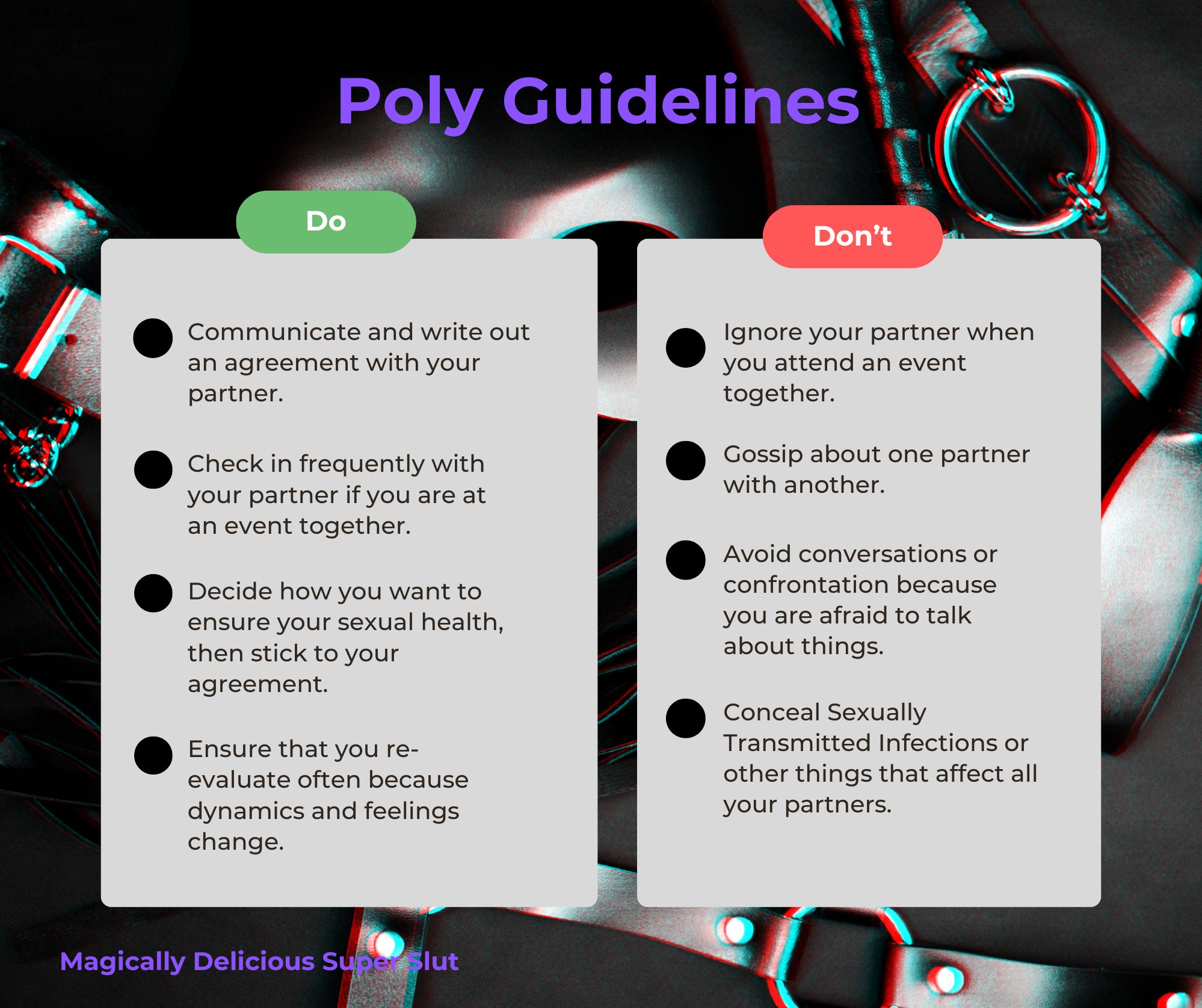
A couple is polyamorous but has rules:
• No sex outside the marriage without using protection.
• Any sex where a condom could have broken or one of them could have been compromised, and they wait two weeks and get tested before having sex with each other.
• They agree to be honest about what they do with their sexual partners.
Now the husband goes and has sex with his friend, and he does not use a condom. He comes home to his wife, and asks to have sex with her. He assures her that he was safe when he had sex with his friend, and that there is no chance that he could have caught something. Under this understanding, his wife consents to sex.
About a week later the wife has an itching down there. She trusts her husband and assumes it’s just a yeast infection, but the itching persists and she begins to have delicate flesh in her genital area that tears and bleeds.
She goes to her gynecologist and gets tested, and she tests positive for Chlamydia and HPV-8. The gynecologist is unsure if her flesh tearing is due to her autoimmune diseases being aggravated by the Sexually Transmitted Infections (STIs), or if she also has HSV-2.
The wife has not had sex with anyone else in years. She has been tested several times during those years when she was only having sex with her husband, and has never tested positive for an STI before.
Later, the friend whom the husband had sex with confesses that she and the husband never used condoms when they had sex.
Now, you tell me: Is this rape?
The wife said yes to sex, didn’t she? She didn’t object during the sex. So how can it be rape?
Well, again:
You have to have informed consent. If you have rules and you break them, then it’s rape. If you say you used a condom and you didn’t, it’s rape. Any time a woman did not consent, or was coerced into consent with lies, it’s rape.
I know this bothers many people.
When I was growing up, men got me drunk and pushed themselves on me. I froze, because I’m Autistic and I didn’t know how to object. Back then, we didn’t call that rape. Men just thought that if you said yes to a drink, then that meant they could have sex with you while you were lying in a pool of vomit rigid and clearly not having fun.
However, we know better now.
We’ve grown as a society. We discussed it. We thought it over, and it turns out that any kind of sex without consent is rape.
A popular show named “Bridgerton” by the delightful Shonda Rhimes features a woman raping a man in the first season. He is trying not to have a child with his wife by using the pullout method. This method is not very effective, but it was the conditions under which he consented to sex. He did not consent to cum inside his wife.
His wife -who wants a child- holds him tightly when he cums so that he cannot pull out.
This is also rape.
They had terms under which they had sex, and she broke them. And folks, that’s also rape. I know back in the 70’s and 80’s men said stuff like: “Men can’t be raped. Sex is like pizza. Even when it’s bad it’s still good.”
That’s the patriarchy speaking, and we don’t listen to that bullshit around here.
If your partner or partners did not consent to sex, it’s rape. If their consent was not enthusiastic and ongoing, then it’s rape. If they were too drunk or stones to consent, then it’s rape.
I want to take a moment to talk about some of the most magical people in the polyamorous community. They are called Unicorns.
Unicorns are people (most often women) who enjoy dating couples.
An unfortunate thing I often see in the Polyamorous culture is unhappy couples trying to hunt for a unicorn because they think it will fix their marriage.
Remember: No one wants to date an unhappy couple. Unicorns are attracted to love and joy, and if your marriage isn’t loving and joyful, they won’t want to be part of it.
Even if you have a happy marriage, it’s important to remember that the unicorn may not want to do every single thing together with both of you. Many couples fall into the trap of expecting a unicorn to like each of them equally and only want to do things with both of them together. That’s weird. It’s not natural or normal to expect someone to feel exactly the same about both of you and to always want to be with you together.
Let’s step back for a moment and examine what polyamory actually is.
Polyamory is about a lot of things, but the biggest thing you need to practice is being self-aware and managing jealousy well. You will feel jealous when your partner is with someone else, and moreso if they are with someone else without you. That said, you feeling jealous doesn’t automatically mean you should get everything you want. It also doesn’t mean that what your partner is doing is wrong.
When I was married, my husband would get extremely nosey about anyone I was talking to and everything I said. When I tried to go places with anyone other than him, he would invite himself along. In my experience, men are worse at managing jealousy because they’ve been taught that the only feeling they are allowed to have is anger. Anger is probably the least productive emotion and it only causes conflict, so men who want to practice polyamory need to spend a lot of time working on themselves and learning a few important lessons:
• If anger is your default emotion, then you need to fix that. Anger only causes conflict, and it is the least productive of all the emotions.
• Women are people. They each have their own wants and desires. You can’t make assumptions about what they feel or want based on stereotypes that you learned in elementary school or from other ignorant men. Just let her talk and listen to what she says. It’s not that hard.
• You need to learn to recognize when you are feeling jealous. Then, examine why you feel that way. Are those feelings fair? You want to date other people, so your partner should be able to do the same things as you. Sometimes that means spending time with someone with you. Sometimes that means spending time with someone without you. Either way, it is your responsibility to manage your jealousy, not your partner’s responsibility.
Compresion is the term we use to mean that you are happy that someone else is happy. This is the feeling you want to try to cultivate. If someone wants to spend time with your partner without you, it’s important to focus on being glad that your partner is desired, and happy for them that they are having fun. If you can’t do that, then you are not polyamorous. You shouldn’t be dating unicorns or anyone else.
Here’s something you can think about:
A unicorn is coming into a relationship where he or she doesn’t know any of your inside jokes, and where they don’t have any history with either of you. This can feel lonely. Instead of focusing on yourself or your partner, try to spend time focusing on how the unicorn feels, and try to help them feel comfortable.
Unicorns are special people, and they deserve respect and kindness. So, don’t hunt a unicorn because you’re unhappy and you think it will fix your marriage. It won’t. Adding another person to an unhappy situation will just multiple the unhappiness. Instead, fix your issues on your own, become happy and loving, and then watch the unicorns come to you.
























 magicallydelicioussuperslut